

close
Choose Your Site
Global
Social Media


Views: 0 Author: Site Editor Publish Time: 2026-02-23 Origin: Site


Durable compared to what—seam failure, fabric tearing, or long-term reuse under daily carrying conditions? That is the real question behind the popularity of the Ultrasonic Non Woven Bag. Many buyers simply ask for a “strong bag,” but durability is not a single number. It is the result of fabric weight, seam design, handle reinforcement, load cycles, and real-world usage patterns. In this article, we break down durability into measurable dimensions, explain how ultrasonic welding influences performance, and provide a practical checklist you can use before placing an order.
Durability is often misunderstood. For some buyers, it means the bag should not break when carrying groceries. For others, it means the bag should maintain its appearance after multiple uses in a retail environment. These are different types of durability.
Seams are common failure points. Whether stitched or welded, seams connect separate panels of fabric. Stress typically concentrates at corners, bottom joints, and handle attachment points. If the seam fails, the bag fails.
Stitched seams can break due to thread tension, needle perforation stress, or abrasion along the thread line. Ultrasonic welded seams eliminate thread, bonding fibers directly together. This changes the stress distribution along the seam line.
However, seam durability depends on bonding width, seam pattern, fabric thickness, and reinforcement design. A narrow weld on lightweight fabric may perform differently from a wide weld on heavier material. Buyers should always clarify where stress will occur and how much load the seam must carry.
Fabric durability refers to the strength of the non-woven material itself. Even if the seam is strong, a bag may fail if the fabric tears under tension.
Fabric weight, often measured in GSM, plays a major role. Higher GSM generally increases tear resistance, though it also adds weight and cost. Fiber structure and manufacturing quality also influence performance. A durable bag requires balanced design between seam strength and fabric integrity.
Handles are frequently the first component to fail. They experience concentrated stress when the bag is lifted. Handle durability depends on:
Attachment method
Reinforcement patches
Loop length
Fabric thickness around the handle area
Even a strong seam can fail if the handle connection is not properly reinforced. When evaluating durability, buyers should specify expected load and carrying style.
Each of these dimensions—seam, fabric, and handle—fails differently. Understanding which matters most in your application is essential.
Ultrasonic welding is often promoted as a superior construction method. While it offers real advantages, durability should be discussed realistically rather than through exaggerated claims.
One advantage of ultrasonic welding is the elimination of needle holes and thread. Without thread, there is no risk of thread breakage or seam unraveling. Needle holes in stitched seams can create small stress points, especially when exposed to repeated load cycles.
Ultrasonic bonding fuses fibers together, creating a continuous seam line. This reduces fraying along edges and maintains a clean finish over time. For retail packaging and promotional use, this contributes to both structural reliability and visual durability.
Ultrasonic welding uses controlled parameters—frequency, pressure, and time. When properly calibrated, these parameters produce repeatable bonding quality. Consistency reduces variation between production batches.
For large orders, this stability can be an important durability factor. Uniform seam quality means predictable performance. Brands that rely on repeat campaigns benefit from knowing that each batch will perform similarly.
It is important to clarify that ultrasonic welded seam strength is not universally higher than stitched seams in every test. Research has shown that under certain testing methods, stitched seams can achieve higher mean seam strength depending on stitch type, thread quality, and fabric structure.
Why does this happen? Because seam performance is influenced by:
Fabric thickness
Stitch density
Bonding width
Test direction
Load distribution
Ultrasonic welding changes the structure of the seam, but it does not override the laws of material science. The best results occur when welding parameters and fabric selection are properly matched.
Zhejiang Bicheng New Material Co., Ltd., operating as Bicheng Packing Bags, applies ultrasonic welding technology with careful control of fabric specifications. By combining appropriate GSM, welding width, and reinforcement design, durability can be optimized for real-world applications.
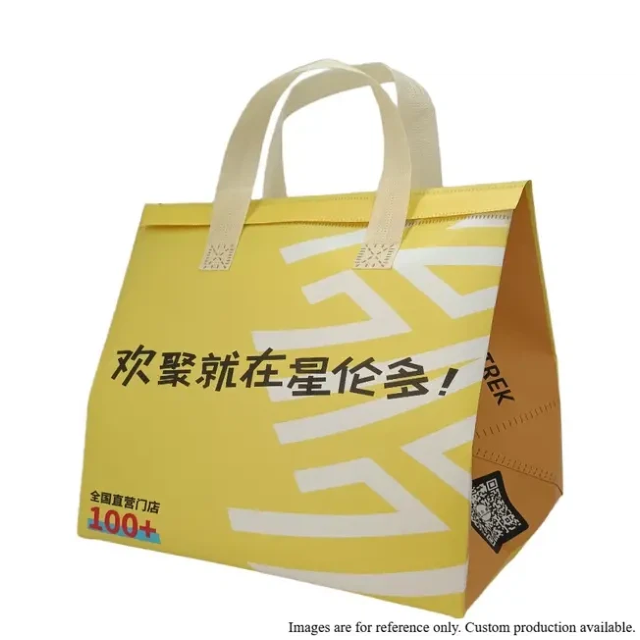
Rather than asking whether one method is stronger in general, buyers should focus on controllable variables.
Fabric GSM directly influences tear resistance and overall strength. For light promotional items, lower GSM may be sufficient. For heavier retail products, higher GSM provides additional durability.
Fiber bonding quality and uniformity also affect performance. A well-manufactured non-woven fabric with consistent density distributes stress more evenly.
In ultrasonic construction, seam width plays a critical role. A wider weld increases bonding area, improving load distribution. Pattern design can also influence stress behavior.
Properly designed weld patterns reduce localized stress points and improve overall seam integrity.
Handles must be designed to match load expectations. Options include:
Ultrasonic bonded loop handles
Reinforced cross patches
Additional fabric layers at attachment point
Handle length and orientation also influence stress. A longer handle may create different load angles compared to a short carry handle.
Bag shape affects durability. Bottom gussets increase volume but also change stress distribution. Side panels, corner folds, and depth all influence how weight is carried.
A well-balanced design ensures that stress is distributed across fabric and seams rather than concentrated at one point.
Buyers do not need complex testing equipment to evaluate durability effectively. Practical tests provide meaningful insights.
A static load test involves placing a defined weight inside the bag and suspending it for a specified duration. For example:
5 kg for 24 hours
8 kg for 12 hours
12 kg for 6 hours
The bag should show no seam separation, tearing, or handle deformation.
A cycle test simulates repeated usage. Lift and carry the bag for a defined number of cycles. For example:
50 carry cycles
100 carry cycles
200 carry cycles
Observe seam integrity and handle attachment after repeated movement.
Humidity and light exposure can affect non-woven materials over time. Simple exposure to humid environments or light splash conditions helps evaluate fabric stability.
Some suppliers provide recommended load ranges based on fabric weight and design. Requesting sample production and performing simple practical tests ensures confidence before full-scale production.
The following table can be used when sending an inquiry to clarify durability expectations.
What to Specify | Example Options | Why It Matters |
Intended load | 3 kg / 8 kg / 12 kg | Defines seam and handle requirements |
Usage cycles | 10 / 50 / 200 carries | Predicts seam fatigue over time |
Fabric GSM | 70 / 90 / 120 | Influences tear resistance |
Handle type | Ultrasonic loop / reinforced handle | Handles are common failure points |
Bag size and gusset | Yes / No + dimensions | Changes stress distribution |
Providing this information allows manufacturers to recommend appropriate design adjustments.
Bicheng Packing Bags specializes in producing durable and customizable non-woven bags for retail, events, gifts, and everyday use. By combining recyclable materials with controlled ultrasonic welding technology, the company supports both sustainability and structural performance.
Are ultrasonic non-woven bags more durable? The direct answer is that durability is not defined by welding method alone. They can be very durable when fabric weight, seam width, handle reinforcement, and bag geometry are properly specified. Durability is a design result rather than a single construction label. A carefully engineered ultrasonic welded non woven bag can provide reliable performance, clean appearance, and long-term usability. To discuss your specific load requirements and usage scenarios, contact Bicheng Packing Bags and explore customized ultrasonic solutions tailored to your packaging needs.
No. Seam strength depends on fabric GSM, bonding width, and test method. Ultrasonic welding eliminates thread failure but must be properly designed to meet load requirements.
The recommended GSM depends on intended load. Light promotional use may require 70 GSM, while heavier retail use may require 100 GSM or more.
Request samples and perform simple load and cycle tests. Define weight and carrying frequency to evaluate performance under realistic conditions.
Yes, when properly specified. Fabric quality, handle reinforcement, and seam design all influence long-term durability.


